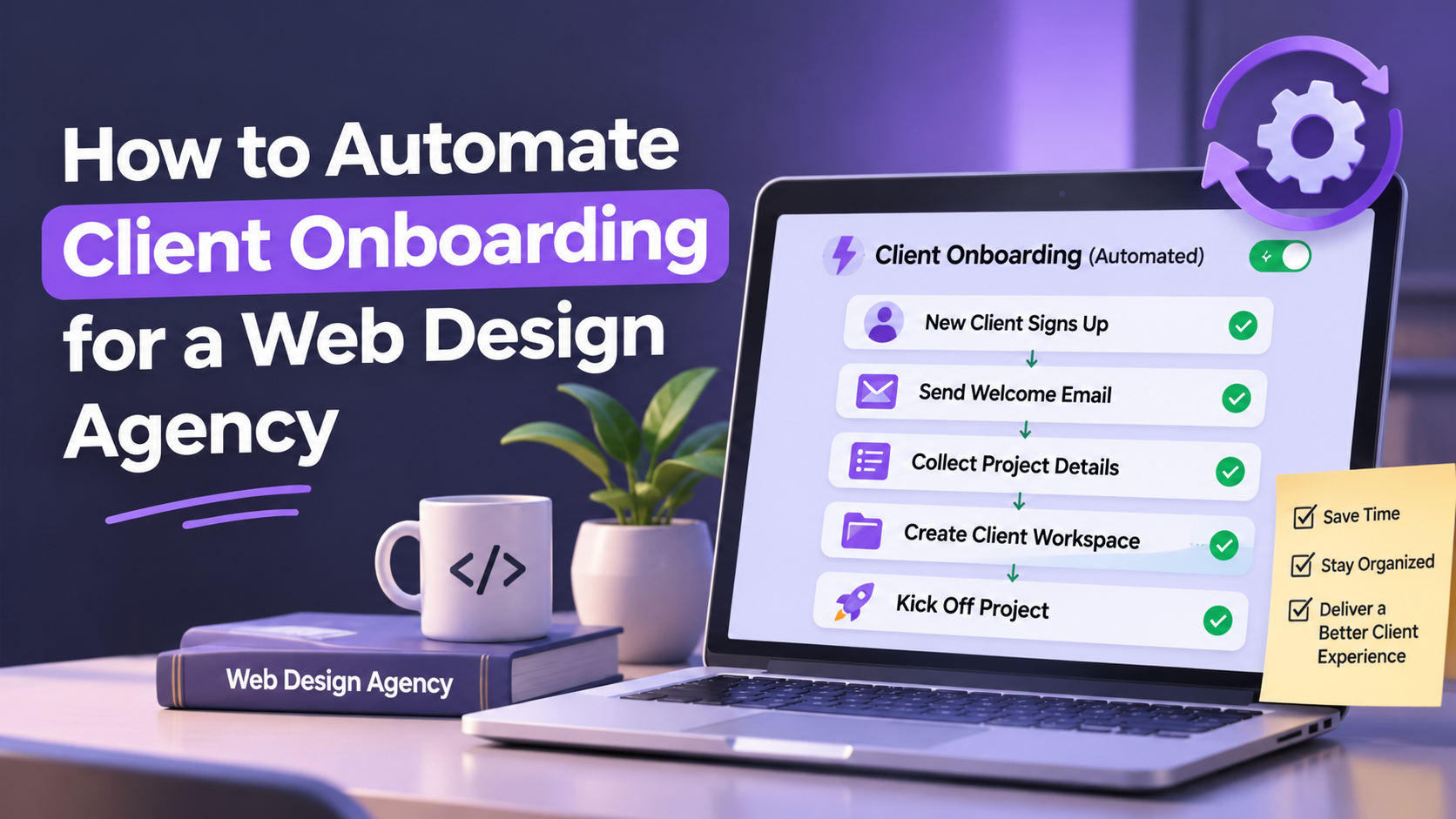
Automating client onboarding for a web design agency means replacing scattered emails, repeated questions, and lost files with a workflow that mostly runs on its own. A system that handles intake forms, contracts, folder setup, and client introductions on autopilot lets designers get to work faster and gives new clients a cleaner first impression. This guide walks through the moving parts and the tools agencies lean on to make it work.
Why automate onboarding in a web design agency
Manual onboarding tends to break the moment an agency takes on more than a handful of clients in the same month. Welcome emails go out late, Figma invites get forgotten, questionnaires sit unanswered, and project managers end up chasing missing brand assets days before the first review. Automation keeps the handoffs on schedule and frees the team to focus on design rather than coordination.
Contracts are usually the slowest link. Legal review, redlines, and signature chasing can stretch a two-day start into a two-week delay, which is why many agencies now use ai contract management on top of their onboarding stack to generate agreements from templates, flag unusual clauses, and route signatures without manual tracking. The time saved compounds across every new engagement, which matters most for teams that take on dozens of small projects a year.
Mapping the web design agency client onboarding workflow
Before any software gets added, the agency needs a written map of what happens from signed proposal to first design handoff. That map becomes the blueprint for every automation that follows and keeps the team from building disconnected zaps nobody understands.
A typical automated client onboarding workflow covers these stages:
- Lead accepts the proposal and payment terms
- Contract is generated, sent, and signed
- Deposit invoice is issued and paid
- Intake questionnaire goes out with a clear deadline
- Welcome packet and timeline are delivered
- Project workspace and shared folders are created
- Client is invited to the project management tool
- Kickoff call is scheduled and confirmed
Each of these can trigger the next through connectors like Zapier, Make, or native integrations inside tools such as HoneyBook, Dubsado, or Notion. Lightweight signing apps like Acceptor fit into this stack when an agency wants a quick way to collect digital sign-offs on scope documents before passing the project into production.
Building a web design client onboarding checklist
A visible web design client onboarding checklist gives both sides a shared view of what has to happen, in what order, and by whom. Guidance from Moxo on web design client onboarding points out that the initial phase can make or break the client relationship, which is why standardizing it matters so much. A checklist also makes automation easier because every item becomes a task that can be triggered, assigned, and tracked.
| Stage | Action | Owner | Automation trigger |
| Pre-contract | Send proposal | Account lead | Deal moved to “won” in CRM |
| Contract | Generate and send agreement | System | Proposal accepted |
| Payment | Issue deposit invoice | System | Contract signed |
| Discovery | Share intake form | Project manager | Deposit paid |
| Setup | Create project workspace | System | Form submitted |
| Kickoff | Book kickoff call | Client | Workspace ready |
Giving the client a live version of this checklist inside a client portal cuts the back-and-forth email volume and signals that the agency runs a disciplined process.
Tools that power an automated client onboarding workflow
Most web design agencies combine three or four tools rather than leaning on a single all-in-one platform. A common pairing includes a CRM for lead tracking, a proposal and contract tool for agreements, a project management app for deliverables, and a client portal for shared updates.
Popular choices include HoneyBook or Dubsado for proposals and contracts, ClickUp or Asana for project management, Notion or Google Drive for shared documents, and Slack or a branded portal for client messaging. The right stack depends on team size, project volume, and how much custom branding the agency wants in the client experience.
Contracts, proposals, and AI contract management
Contracts sit between sales and production, which is why a signature delay holds up every later step. Agencies that fold ai contract management into their onboarding flow generate agreements from pre-approved templates, auto-fill client details from the CRM, and surface non-standard clauses that need a human review. According to Docusign’s analysis of AI in agreement workflows, organizations using AI-powered agreement management report an average 36% efficiency gain through time savings and cycle time reduction. ai contract management also pulls obligation data into dashboards so the team can see renewal dates, milestone payments, and scope limits at a glance.
For agencies that run recurring work — monthly retainers, maintenance plans, hosting bundles — this shifts the agreement from a static PDF into an active part of the client relationship. AI-powered contract tools support cleaner upsells and fewer awkward renewal conversations, especially when clauses stay consistent across every account.
Metrics that confirm the automated client onboarding workflow works
Numbers matter. Without them, it is hard to tell whether the automation is really saving time or just adding complexity. Useful metrics to track include:
- Time from signed proposal to kickoff call
- Average hours of account manager time per onboarding
- Percentage of intake forms completed on time
- Client satisfaction score at the end of week one
- Number of manual follow-ups required per project
Reviewing these numbers once a quarter shows which stages still need attention and which automations earn their keep.
Final thoughts on automating client onboarding for a web design agency
For a web design agency, the measurable payoff is specific: onboarding time usually drops from two weeks to three business days, account manager hours per client fall by roughly half, and intake form completion rates climb above 85% once reminders are automated. The sequence that delivers those numbers is consistent across agency sizes — write the workflow on paper, add ai contract management to handle agreements, connect a project tool that assigns tasks on contract signature, and give clients a portal where they can see every open item. Agencies that complete those four moves in order tend to recover the equivalent of one full-time coordinator’s hours within a quarter and start every new project with brand assets, approvals, and timelines already in place.